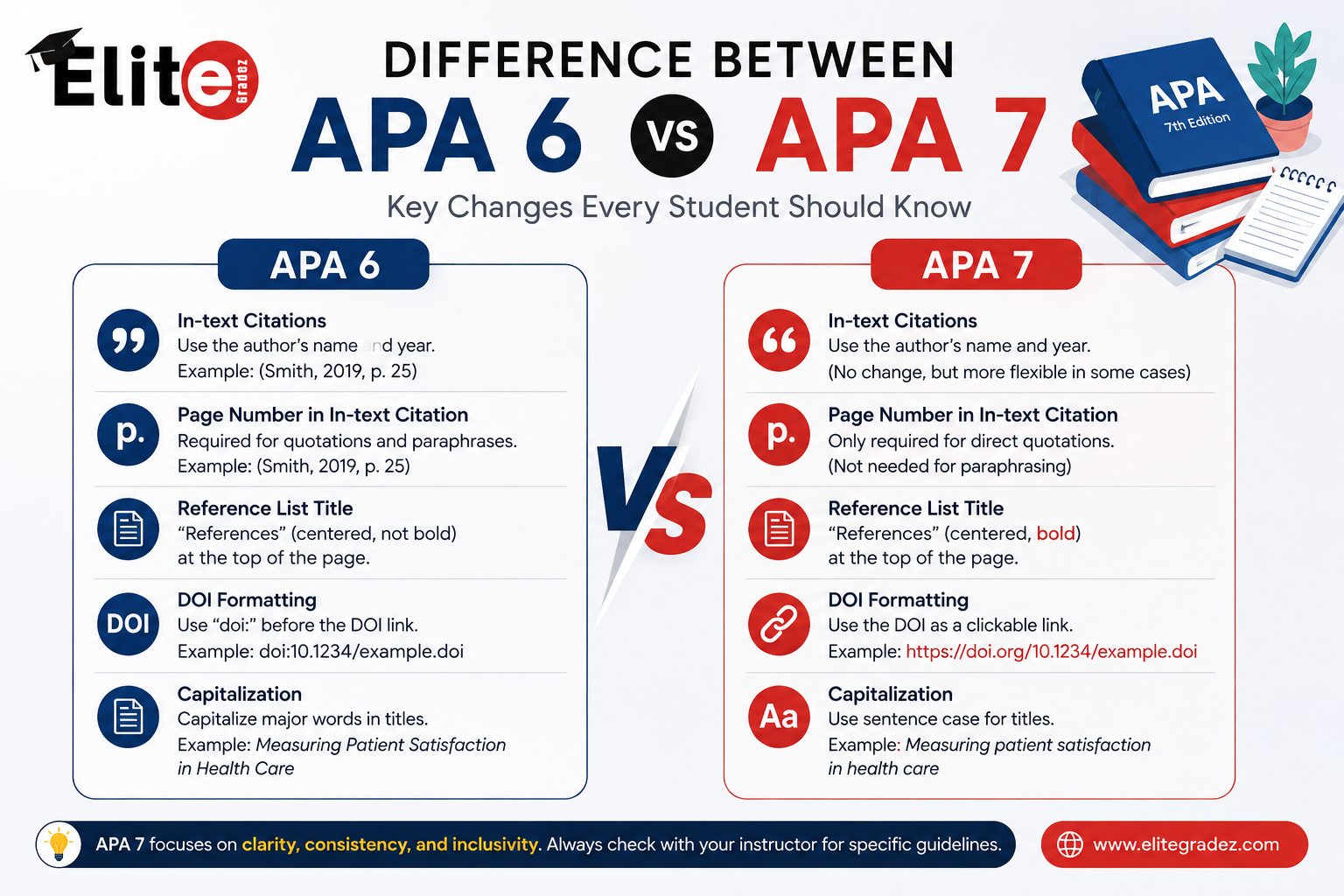
Academic writing requires precision, and for millions of students, the American Psychological Association (APA) style is the gold standard for formatting research papers. In late 2019, the APA released its seventh edition, introducing significant updates. For students transitioning between degree programs, understanding the difference between APA 6 and APA 7 is critical for maintaining academic integrity. This guide provides a detailed breakdown of the most impactful changes, ensuring your next submission meets current scholarly standards.
Why the Update? The Evolution of Scholarly Communication
The transition from the sixth edition (2009) to the seventh edition (2020) was driven by the need to simplify formatting for the digital age. As online resources and inclusive language became central to academic discourse, older guidelines began to feel outdated. The primary difference between APA 6 and APA 7 lies in the simplification of student paper requirements and the standardization of digital citations. By streamlining these rules, the APA has made it easier for students to focus on research rather than complex formatting minutiae.
Key Formatting Changes: Student vs. Professional Papers
1. The Title Page and Running Head
In APA 6th edition, every paper required a “Running head” on the title page, formatted as Running head: TITLE IN ALL CAPS. In the 7th edition, student papers no longer require a running head unless requested by the instructor [1]. For professional papers, the “Running head:” label has been removed, leaving only the shortened title in all caps.
2. Flexible Font Choices
The difference between APA 6 and APA 7 also extends to typography. While the 6th edition almost exclusively recommended 12-point Times New Roman, the 7th edition offers greater flexibility. Students can now use Calibri 11, Arial 11, or Georgia 11, alongside the traditional Times New Roman 12, improving accessibility for all readers.
Major Changes in Citations and References
The way we cite sources has seen a dramatic overhaul to accommodate modern research habits. Understanding these nuances is essential, as citation errors are a common reason for point deductions a main difference between APA 6 and APA 7.
3. In-Text Citations (The “Et Al.” Rule)
In the 6th edition, you were required to list all authors (up to five) in the first citation and use “et al.” thereafter. The difference between APA 6 and APA 7 is now much simpler: for any work with three or more authors, you use “et al.” from the very first citation [2] [5]. This significantly reduces the length of parenthetical citations in research-heavy papers.
4. The Reference List: Less is More
The 7th edition has removed several redundant elements from the reference list:
•Publisher Location: You no longer need to include the city and state of the publisher.
•”Retrieved from”: This phrase is now omitted before URLs unless a retrieval date is necessary.
•DOI Formatting: DOIs are now formatted as active URLs (e.g., https://doi.org/10.xxxx/xxxxx ) rather than the older doi:10.xxxx format [5].
5. Author Limits in References
In APA 6th, only the first seven authors were listed before using an ellipsis. The 7th edition now allows you to list up to 20 authors before needing to use an ellipsis, providing better credit to research teams [12].
FAQ: Common Questions About APA Transitions
Navigating the difference between APA 6 and APA 7 often leads to common questions regarding which version to use and what the future holds for academic formatting.
Is APA6 or APA7 better?
APA 7 is objectively more modern and user-friendly. It simplifies many of the tedious aspects of the 6th edition, such as the running head for students and complex “et al.” rules. Most universities now mandate APA 7 because it better accommodates digital sources and inclusive language.
Is APA 6 and APA 7 the same?
No, they are not the same. While the core philosophy of clear writing remains, there are technical differences in how title pages are formatted, how authors are cited in-text, and how reference lists are constructed. Submitting a paper in APA 6 when APA 7 is required can lead to grading penalties.
Is APA 6th or 7th more common?
As of 2026, APA 7th edition is the standard across almost all academic institutions. While some faculty members might still reference 6th edition rules, the APA officially transitioned to the 7th edition in 2020, making it the current and most common version in use today.
Will there be an APA 8th edition?
There is currently no official announcement regarding an APA 8th edition. Historically, the APA releases a new manual every 10 to 12 years. Given that the 7th edition was released in late 2019, it is likely to remain the standard for several more years. For now, students should focus exclusively on mastering the 7th edition guidelines.
Conclusion
Mastering the difference between APA 6 and APA 7 is a vital skill for any serious student. By adopting the simplified formatting, flexible font choices, and updated citation rules of the 7th edition, you can ensure your work is professional and compliant with modern academic standards. If you ever feel overwhelmed by these changes, the experts at Elitegradez are always available to provide comprehensive academic support and guidance.
References
•[1] Purdue OWL – Changes in the 7th Edition
•[2] APA Style – Comparison of the Sixth and Seventh Editions
•[5] Scribbr – APA 7th Edition (2020) | The 17 Most Notable Changes
•[12] University of Lincoln – Main changes from the 6th edition to the 7th edition of APA
